Our annual reports

NZSIS Annual Report 2025

This is the annual report of the New Zealand Security Intelligence Service (NZSIS) for the year ended 30 June 2025.

Preface

This is the annual report of the New Zealand Security Intelligence Service (NZSIS) for the year ended 30 June 2025, presented for consideration and scrutiny by the Intelligence and Security Committee.

This report is presented to the House of Representatives pursuant to section 221 of the Intelligence and Security Act 2017.

This work is licensed under the Creative Commons Attribution 3.0 New Zealand license. In essence, you are free to copy, distribute and adapt the work, as long as you attribute the work to the Crown and abide by the other license terms. To view a copy of this license, visit http://creativecommoncs.org/licences/by/3.0/nz/. Please note that no departmental or governmental emblem, logo or coat of arms may be used in any way that infringes any provision of the Flags, Emblems, and Names Protection Act 1981. Attribution to the Crown should be in written form and not by reproduction of any such emblem, logo or coat of arms. 

Foreword

Director-General’s foreword

New Zealand is facing the most challenging national security environment of recent times. Our Annual Report outlines in considerable detail the unique and highly valued contributions the NZSIS has made to New Zealand’s national security in this challenging environment over the past year. However, national security is not something that can be left to our agency alone. 

It remains important to us that we talk to New Zealanders about this as much as we can, and engage with New Zealanders about mitigating national security risks. A strategic focus of our work is to deliver impact with and for others. This is about working with groups and organisations from around New Zealand to keep our country safe and secure. We also work closely with like-minded partners to support New Zealand’s national security interests and keep New Zealanders safe.

While secrecy remains crucial for us to be able to do our jobs, there is a clear need to balance that with New Zealanders’ right to know what we do in their name and the threats we face as a country. You will see this reflected in our reported performance measures in this report. There are some aspects of our work that lend themselves to quantitative performance measures, such as vetting - where I am pleased to say we exceeded our targets. But for other areas, such as intelligence, it can be harder to give a quantitative measure of success.

New Zealand faces a varied and complex number of security threats. Foreign interference activities continue in New Zealand with several states responsible. This includes activities regarded as transnational repression that often target diaspora communities. Some foreign states attempt to exploit people in a deceptive, corruptive, or coercive manner, to gain influence and further their interests. In addition, we have seen some foreign states target New Zealand’s critical organisations, infrastructure and technology.

The level of foreign interference activity in New Zealand remains an ongoing concern for us. Foreign interference has the potential to harm New Zealand’s ability to act in our own interests as an independent nation. No one living in New Zealand should have to put up with any activity that limits their rights and freedoms. We remain alert to this threat and continue to call out this behaviour.

We also remain alert to the threat of violent extremism and terrorism. The most plausible domestic violent extremist attack scenario remains a lone actor who has radicalised online and prepares for violence without any intelligence forewarning. Grievances and polarising issues in the online information space are almost certainly driving support for a range of violent extremist ideologies within New Zealand. No single ideology currently stands out as presenting a greater threat than the others, but young and vulnerable people in New Zealand are particularly at risk of radicalisation. Our resources, including our annual threat environment report, can help inform New Zealanders of the challenges we face as a country, and help us work together to address them. 

NZSIS is continually working with our domestic and international partners to detect and investigate individuals who may be radicalising to violent extremism or conducting foreign interference and espionage activity against New Zealand or the Pacific. However, the NZSIS is not an all-seeing security intelligence agency, and nor should we be, in a democracy like New Zealand’s. More often than not, members of the public will see concerning behaviours and activities before we do. It remains important that this sort of concerning behaviour is reported either to us or NZ Police; this can be done anonymously.

Like other public services agencies, the NZSIS has been operating in a more fiscally constrained environment this reporting year, while continuing to deliver more value for the people we serve. Together with the Government Communications Security Bureau (GCSB), we undertook a change process in 2024/25 as part of a joint financial sustainability programme, to ensure we are efficient, financially sustainable, and well-equipped to face the evolving threatscape. We are cognisant of the ongoing fiscal constraint that we continue to operate under.

We could not have achieved this without the commitment and talent of our diverse staff. I remain deeply grateful for all their hard work.

Ngā mihi nui,

Andrew Hampton
Te Tumu Whakarae mō Te Pā Whakamarumaru
Director-General of Security

Statement of Responsibility

I am responsible as Director-General of the New Zealand Security Intelligence Service (NZSIS) for:

  • The preparation of the NZSIS’s statement of expenses and capital expenditure, and for the judgements made in them;

  • Having in place a system of internal control designed to provide reasonable assurance as to the integrity and reliability of financial reporting;

  • Ensuring that end of year performance information on each appropriation administered by the NZSIS is provided in accordance with sections 19A to 19C of the Public Finance Act 1989, whether or not that information is included in this annual report; and

  • The accuracy of any end of year performance information prepared by the NZSIS, whether or not that information is included in the annual report.

In my opinion:

  • This annual report fairly reflects the operations, progress and organisational health and capability of the NZSIS; and 

  • The Statement of Expenses and Capital Expenditure against Appropriation fairly reflects the total actual expenses and capital expenditure incurred for the year against the NZSIS’s appropriation for the financial year ended 30 June 2025.


Andrew Hampton
Te Tumu Whakarae mō Te Pā Whakamarumaru
Director-General of Security

30 September 2025

Who we are and what we do

Our mission

Our mission is keeping New Zealand and New Zealanders safe and secure.

Our functions

We operate under the Intelligence and Security Act 2017 (ISA), the purpose of which is to protect New Zealand as a free, open, and democratic society. To effectively do this, we are charged with four core functions:  

  • intelligence collection and analysis
  • protective security services, advice and assistance
  • co-operation with other public authorities to facilitate their functions, and
  • co-operation with other entities to respond to imminent threat. 

The NZSIS is New Zealand’s domestic security intelligence agency and lead organisation for human intelligence (HUMINT). We collect and analyse intelligence in line with the Government’s priorities to provide decision-makers with sound national security advice. We also provide a range of protective security services to other government agencies. While primarily domestic focused, our work in the Pacific is becoming of increasingly important as a result of geostrategic competition in the region.

Our people

Our people come from across our society and work in a variety of roles. As at 30 June 2025, the NZSIS has 396.1 full time equivalent (FTE) employees. We have shared enablement functions with the Government Communications Security Bureau (GCSB). Many of our shared staff are employed by the GCSB but work across both agencies. This supports ease of cooperation between our agencies in a cost efficient manner.

Our funding

We are funded through Vote Security Intelligence. The Minister Responsible for the NZSIS is responsible for the single appropriation within this Vote.

The NZSIS’s Statement of Expenses and Capital Expenditure Against Appropriation is on page 40.

Progress on strategic intentions

Performance framework

Our Mission

Keeping New Zealand and New Zealanders safe and secure.

We support protecting New Zealand as a free, open, and democratic society by contributing to:

  • the protection of New Zealand’s national security
  • the international relations and well-being of New Zealand
  • the economic well-being of New Zealand

We achieve this through:

  • Security Intelligence: Detecting, investigating, assessing and mitigating threats to New Zealand. 
  • Foreign Intelligence: Collecting, analysing, and sharing intelligence to further New Zealand’s interests and those of our region. 
  • Protective Security: Providing services and advice so New Zealand government agencies and organisations can protect their people, information and other assets. 

 
Our contributions to National Security can be seen through achieving our four impacts:

  • Countering espionage and foreign interference: Detecting, investigating and disrupting activity in or against New Zealand. We act as the lead agency in seeking to understand and assess these threats so action can be taken to disrupt and deter. 
  • Countering violent extremism and terrorism: Detecting and investigating threats posed by violent extremism in New Zealand and overseas and working with other agencies to stop these threats escalating into acts of terrorism.
  • Protecting people, information and assets: Enhancing the ability of New Zealand government agencies and organisations to protect their people, information and other assets through our Protective Security leadership role.
  • Contributing to a secure, prosperous and resilient Pacific: Working with others to detect, disrupt and deter activities which undermine New Zealand’s national security and that of our partners in the Pacific. This includes supporting Pacific partners to build their protective security.

By pursuing our strategy, we will drive progress in the following three focus areas

Delivering impact with and for others:

  • New Zealand and New Zealanders have trust and confidence in us 
  • We maximise our impact through relationships

Improving our ways of working:

  • We are a learning and innovative organisation
  • We focus on discovering unknown threats
  • We provide a fantastic place to work

Utilising data and digital:

  • We are modern and experiment with technology 
  • We have expert data and digital capabilities

Our organisational strategy

The NZSIS Strategy 2024-2029 is focused on continuously improving our ability to find, understand and mitigate threats.

We live in a complex and ever-changing world where we face new challenges every day in our ability to identify, understand and mitigate threats. The NZSIS needs to continually ensure we are robust and ready to respond to whatever the future might bring. In late 2023 we completed a refresh of the NZSIS Strategy to ensure our capabilities remain relevant and can evolve in line with New Zealand’s changing security environment.

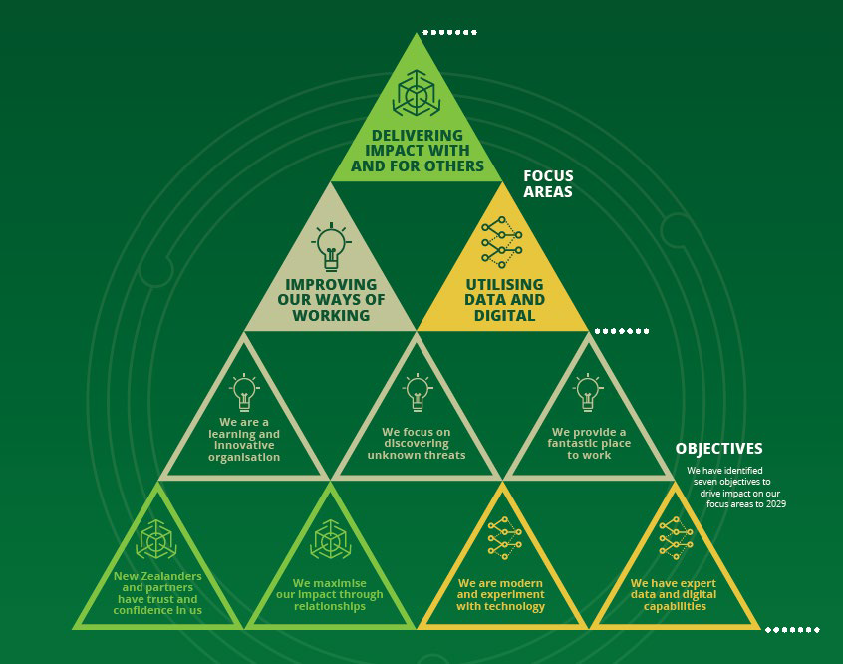
The key components of the strategy are set out below.

Green infographic showing a triangular framework of organisational priorities. At the top: Delivering impact with and for others. Beneath are two focus areas: Improving our ways of working and Utilising data and digital. Lower rows contain objectives consisting of: We are a learning and Innovative organisation, We focus on discovering unknown threats, We provide a fantastic place to work, New Zealanders and partners have trust and confidence in us, we maximise our Impact through relationships, We are modern and experiment with technology, and We have expert data and digital capabilities.

Assessment of operations

Part A: Implementing the Government’s priorities

The NZSIS works to the New Zealand Government’s National Security Intelligence Priorities – Whakaarotau Marumaru Aotearoa (NSIPs). These define key areas of national security interest, assisting agencies with related roles to make informed, joined-up decisions. Some of the NSIPs that relate to the NZSIS are:

  • foreign interference and espionage
  • New Zealand’s strategic interests in the Pacific region
  • terrorism and violent extremism
  • global governance and strategic competition, and
  • threats to New Zealanders overseas. 

Our contribution to the NSIPs is reported throughout the report.

Baseline savings

The NZSIS baseline was reduced by $3.44 million in 2024/25 through the Budget 2024 Initial Baseline Exercise. We achieved the savings targets through efficiency savings that could be managed without having a significant impact on current operational activity, such as reducing spend on contractors and consultants, training and development, travel, and reduced financial contingencies. In order to address ongoing cost pressures we reallocated staff between the NZSIS and the GCSB to strengthen enablement functions, reduce duplication, and disestablished some leadership positions while maintaining front line personnel. 

Part B: Assessment of Operations

The NZSIS’s mission is to keep New Zealand and New Zealanders safe and secure. To achieve this, we work closely with New Zealand’s national security community, and a growing number of other agencies, on issues that cross multiple agency mandates, sectors and priorities. Our success is more likely to be preventing something from happening, identifying and mitigating a risk, or building understanding and resilience against national security threats.

The majority of our performance information is classified and cannot be released publicly. Where performance information is unclassified and can be released, it is set out in the following pages.

You can read case studies of our work in New Zealand’s Security Threat Environment 2025 on the NZSIS website. 

Countering espionage and interference

The NZSIS investigates and seeks to mitigate possible espionage and foreign interference threats taking place in or against New Zealand. We seek to understand and assess the threats and provide timely advice and intelligence reporting to help counter these activities.

The NZSIS detects, deters and disrupts foreign state adversaries form undertaking high harm intelligence and interference activities targeting New Zealand and New Zealand’s interests, including those in the Pacific.

Contributing to a secure, prosperous and resilient Pacific

New Zealand has a critical, long-term and non-discretionary stake in supporting and advancing peace, stability, prosperity and resilience in the Pacific. In short, what happens in the Pacific has a fundamental impact on New Zealand’s own national security, prosperity and identity. As outlined in the NZSIS Strategy 2024-2029, our role is to work with our Pacific counterparts and others to detect, disrupt and deter activities that undermine New Zealand’s national security and that of our partners in the Pacific. This includes supporting Pacific partners to build their protective security. 

The NZSIS has a clear role to play in achieving the outcomes sought under the Government’s Pacific Resilience objectives and regional commitments. In doing so, our work in the Pacific contributes to both security intelligence and foreign intelligence services for the New Zealand Government.

Countering terrorism and violent extremism

The NZSIS investigates violent extremism threats against New Zealand’s interests and works with other agencies to prevent these threats from escalating into acts of terrorism.

The NZSIS assesses whether existing threats are increasing or diminishing, and works to detect and understand new or emerging threats. The NZSIS looks at global and domestic events and developments relating to violent extremism in order to understand the possible impact on violent extremist activity in New Zealand.

Case study

Raising awareness of young people in violent extremism

Context

The NZSIS, along with our domestic and international partners, are increasingly concerned about young people interacting with violent extremist material and the increase in the number of young people who support, plan or undertake terrorist activities.

Vulnerabilities, such as mental health difficulties or other complicating factors create additional layers of challenge when assessing threat and risk. This phenomenon is apparent in New Zealand – in 2024/25, the number of leads the NZSIS opened on minors more than doubled compared to the year prior.  

What we did

Throughout 2024, we have worked closely alongside our partners to write and publish an unclassified Five Eyes Insights paper on this issue: Young people and violent extremism: a call for collective action. The paper includes New Zealand-specific case studies. The purpose of the paper was to inform the public of the challenges we face in this space and highlight the need for an all-of-society response to this issue. 

Throughout the year we have sought opportunities to speak about this issue in our public engagements with relevant stakeholders. For example, we presented on the continuing trend of young people in violent extremism to the Secondary Principals Association of New Zealand’s (SPANZ) board and at their annual conference, engaged at individual high schools across the North and South Islands.  

Our impact

As a direct result of our engagement throughout the year on this issue, we have received lead information from teachers and principals of schools in New Zealand about young people in their schools who they are concerned are becoming radicalised.

The SPANZ executive expressed sincere gratitude for our presentations and offered to facilitate further planned engagement.

The Combined Threat Assessment Group

The Combined Threat Assessment Group (CTAG) is an interagency group hosted and led by the NZSIS that provides independent assessments and advice to inform the National Security System and wider government agencies of the physical threats to New Zealanders and New Zealand interests posed by terrorism, violent extremism and violent protest both domestically and internationally, and violent crime offshore. 

The CTAG provides strategic insight, threat assessment and advice, and intelligence support to inform New Zealand Government and Ministerial decisions, including those related to:

  • The setting of New Zealand’s National Terrorism Threat Level.
  • Security preparations and arrangements for designated domestic and international major events.
  • Travel advisories and protective security arrangements for those travelling internationally, including internationally protected persons visiting New Zealand.
  • The designation of terrorist entities under the Terrorism Suppression Act 2002.

National Security Assessments

The NZSIS provides intelligence reporting and assessment to New Zealand Government agencies to inform decision making, provide assurance, and build New Zealand’s resilience and responsiveness to national security harms including terrorism, espionage, and foreign interference.  

The NZSIS monitors for harmful activity occurring through vectors that those seeking to harm New Zealand may seek to exploit. This includes investments into sensitive sectors, and regulated outer-space activities. Our work is responsive to individual activities or events but increasingly advises at a thematic or strategic level to inform system and sector responses to known and emerging threats in areas of heightened national security importance.

Collectively, our national security assessment work hardens the New Zealand environment against national security threats and contributes to keeping New Zealand and New Zealanders safe.

Average monthly demand of national security clearance applications.
  2020/21 2021/22 2022/23 2023/24 2024/25
Advice under Part 3 of the Overseas Investment Act
Number of transactions we 
provided advice on
N/A 52 23 47 52
Percentage of transactions 
that we provided advice on 
within 10 working days of 
receiving notification
N/A 90% 100% 100% 100%
Advice under Outer Space and High-altitude Activities Act 2017 (OSHAA)
Number of security 
assessments on space-related 
activities under OSHAA
18 19 18 21 28
Percentage of assessments 
provided within 30 days of 
receiving notification
Not recorded Not recorded Not recorded 100% 100%
Other
Number of security 
assessments in support of the 
Radio Spectrum Licencing 
Regime
Not recorded 55 45 74 65

Border Screening

The NZSIS carries out national security assessments and checks relating to the movement of people across borders, into sensitive physical areas, as well as the appointment of people to some Crown boards. The NZSIS primarily seeks to detect individuals with links to terrorist and violent extremist groups, or those with covert links to illicit foreign interference or espionage actors. The advice the NZSIS provides is integral to aiding a wide range of Government agencies to manage national security risks and protect the integrity of New Zealand’s immigration system and passport.

During the reporting period we provided national security assessments on the following:

  • Applications for visas issued by Immigration New Zealand
  • Applications for New Zealand citizenship issued by the Department of Internal Affairs
  • Aviation Security Clearances granted by the Civil Aviation Authority
  • Crown Board appointments to a range of Government agencies. 

We continue to take a risk-based approach to prioritisation that ensures responsiveness to the changing threat environment and Government priorities, and to meet an increasing demand for the national security assessment service.

During 2024/25, we successfully delivered a multi-year project implementing changes that improve the efficiency and effectiveness of our National Security Check process

External Engagement

Engagement is an important tool which enables the NZSIS to discover, understand and share information.  Engagement has the potential to enhance the impact of our services, improve national security outcomes, and grow New Zealanders’ resilience to the threats we face as a society. 

While the NZSIS has always carried out engagement with a variety of stakeholders, the formal establishment of a dedicated Engagement function in 2023 has enabled a strategic approach to engagement. It has allowed us to improve the co-ordination and collaboration of engagement efforts across our agency and with our partners across government. This has improved the efficiency and effectiveness of our engagement, maximising our reach and enabling us to deliver impact with and for others. 

During 2024/25, we:

  • Averaged 75 engagements a month with communities, local government, education and the private sector. 
  • Sought to make intelligence available and impactful for a wider audience by deliberately designing and sharing information at an unclassified level.  This included our New Zealand Security Threat Environment Report 2024, which was downloaded 17,198 times. 
  • Adopted new engagement methods to expand our reach including webinars, conferences and events, and a new community newsletter which provides information in a digestible way for New Zealanders. 
  • Partnered with stakeholders on publications, and methods of disseminating information. For instance, we have collaborated with the Ministry for Ethnic Communities (MEC) to translate some NZSIS material into 30 different languages and have facilitated events with Police, DPMC, GCSB and the Department of Internal Affairs.

Protective Security Requirements

The NZSIS is responsible for managing the New Zealand Government’s Protective Security Requirements (PSR) framework. The PSR provides advice and guidance to support organisations to build their security capability across the four pillars of security governance, personnel security, information security, and physical security. It outlines 20 mandatory requirements, which provide a foundation for strong security practice, as well as a capability model and information to support organisations to develop a security system that is scalable and fit for their individual environments. The PSR framework and support mechanisms are continually reviewed and updated to ensure they remain best practice. 

During 2024/25, we:

  • Improved protective security capability through effective engagement with government agencies, including the facilitation of PSR practitioner and Chief Security Officer (CSO) strategic forums, one-on-one engagements with agencies, and bi-monthly newsletters. These engagements enable information sharing and best practice among agencies, and allow us to provide updates on key protective security developments. 
  • Piloted a new PSR Assurance Framework and Self-Assessment Tool, aimed at creating a better system for agencies to check they have the right protective security measures in place. 
  • Thanks to awareness raising efforts, particularly regarding foreign interference and espionage, there has been increased demand for guidance and advice on how to identify, manage and mitigate the risks. To meet this demand, the NZSIS published six pieces of publicly available PSR guidance in 2024/25 including Secure Innovation, Trusted Business, Managing Inwards Visits and Travelling Overseas on Business. 
  • Continued to support our Pacific neighbours by providing protective security advice and assisting them to develop protective security frameworks which will increase resilience to a range of threats.

Security Services for the NZIC and New Zealand Government

The NZSIS provides security services for the New Zealand Intelligence Community including operational advice and guidance, physical security, insider threat and personnel security. We also provide some protective security services to other New Zealand government departments, including countering national security insider threats and certification of high security areas. 

The NZSIS is responsible for leading the discovery, investigation, and assessment of actual or potential insider threats within government. When investigating potential insider threats, the NZSIS prioritises investigating activity indicative of higher harm to New Zealand’s national security, such as: 

  • unauthorised disclosure of official information (whether it is classified, or not)
  • theft or sabotage or New Zealand Government resources or assets that adversely effects national security
  • behaviour indicative of espionage, loyalty to foreign interests, or support for violent ideologies.

The NZSIS’s work in this area extends to establishing best practice for identifying and mitigating insider threats, and working with government agencies to prevent, mitigate, and respond to actual or potential insider threats.

National Security Clearances

The NZSIS has a statutory responsibility for administering New Zealand’s national security clearance vetting process. This role enables us to support effective security across the public sector, by ensuring only those people who are suitable for handling classified information are in a position to do so.

We advise whether a person is suitable for a national security clearance, or whether any risks need to be managed in order for them to hold a clearance. The process can include looking into a candidate’s background, lifestyle and any other relevant information. The chief executive of the requesting agency makes the final decision about granting a national security clearance.

During 2024/25, we:

  • Focused on reducing backlogs, maintaining high quality recommendations and strengthening internal capability. Long-term initiatives reached maturity resulting in measurable gains in timeliness and efficiency.
  • Met our target of completing 98 percent of priority security clearance applications on time (comparative data below). The target was achieved for the first time. These results highlight the maturity of workflow planning improvements and the ability to balance competing operational pressures. 
Demand for security clearances

The overall demand for security clearances from across government decreased by 16 percent compared to the previous year, easing overall pressures. While total demand fell within forecasts, the composition varied.  

The make-up of demand created pressure in higher-volume areas where resourcing could not be scaled quickly. Confidential and Secret remain the most heavily requested levels with a typical volume of 72 percent of total demand. This meant that even the modest surges in these levels had a large operational impact in comparison to Top Secret and Top Secret Special. This led to longer queues for Confidential and Secret, and extended total application times1 for Secret. While efforts were made to improve efficiency, quality and standards were not compromised. This was important due to the high number of complex applications relating to mental health, and alcohol and drug use.

1 The total application time is from the time NZSIS receives an application to the time a recommendation is made.


Average monthly demand of national security clearance applications
 Clearance Type 2022/23 2023/24 2024/25
Confidential 206 256 210
Secret 144 208 205
Top Secret 136 184 135
Top Secret Special 45 41 29
Total 531 689 579
Security clearance complexity

Complex applications require specialised vetting staff to undertake more extensive enquiries to gather further information from other government agencies and third parties. These complex applications take considerably more time and effort to complete.

There has been a 26 percent decrease in the total number of complex applications but total numbers remain high compared to previous years. Volumes are elevated due to the detailed information collected through Tiaki, the security clearance management system launched in 2022/23

Total number of complex applications
 Clearance Type 2022/23 2023/24 2024/25
Confidential 645 1,148 857
Secret 550 915 706
Top Secret 441 492 397
Top Secret Special 126 132 83
Total 1,762 2,687 2,043
Priority security clearances

The number of priority2 applications are unchanged from the previous year. These applications make-up 61 percent of total recommendations. These applications have specific due dates and are prioritised to meet tight deadlines often driven by specific agency needs, deployments, postings, operations, new staff or renewals.

Demand for priority clearances
 Clearance Type 2022/23 2023/24 2024/25
Confidential 807 1,624 1,401
Secret 504 1,243 1,528
Top Secret 814 1,459 1,050
Top Secret Special 285 236 216
Total 2,410 4,562 4,195

 
2 Priority applications have a due date submitted by the agency.

Delivery of priority security clearance applications
Target 2019/20 2020/21 2021/22 2022/23 2023/24 2024/25
95% of all priority applications are delivered by their due date 71% 80% 81% 85% 89% 98%
Total inventory levels of security clearance

Total inventory reduced by 26 percent compared to the previous year. This distribution across all clearance levels is now more balanced. Confidential accounts for 30 percent of inventory and Secret 31 percent. Top Secret, previously over-represented at 65 percent has decreased to 32 percent. Top Secret Special now represents 8 percent. This shift reflects a healthier and more sustainable distribution.

The reduction in total inventory is due to both a return in demand to expected levels for Top Secret and Top Secret Special, and targeted operational improvements. The most significant change was Top Secret, where the queue size fell by 69 percent. Whereas, Confidential and Secret queues increased following a sharp increase of demand in the final quarter.

Total inventory levels of security clearances
 Clearance Type 2021/22 2022/23 2023/24 2024/25
Confidential 123 381 162 301
Secret 100 342 170 306
Top Secret 217 464 878 317
Top Secret Special 50 133 150 76
Total 488 1,320 1,360 1,000
Total application time

The total median application time3 for all standard security clearance applications remain within agreed timeframes. The median application time for Confidential remained steady at 5 working days, Secret increased to 8 working days, Top Secret reduced to 30 working days, and Top Secret Special reduced to 31 working days.

These results reflect a mix of stability, increased pressure, and improvements across our process. Confidential consistency was due to stable demand until the final quarter. Top Secret and Top Secret Special reductions were due to demand settling to expected levels, and a targeted approach which helped clear previous backlogs. In comparison, Secret experienced ongoing high demand since January 2025. This led to longer wait times for processing applications.

 
3 The median total application time is from the time NZSIS receives an application to the time a recommendation is made. This measured in median working days.

Median application time for security clearances
Clearance Type 2022/23 2023/24 2024/25 Target
Confidential 14 5 5 15 working days
Secret 14 5 8 15 working days
Top Secret 39 52 30 50 working days
Top Secret Special 34 59 31 60 working days

Part C: Year-end performance information on appropriations

How we measure performance

Reporting entity

The NZSIS is a New Zealand government department as defined by section 5 of the Public Service Act 2020. The relevant legislation governing our operations includes the Public Finance Act 1989, Public Service Act 2020 and the Intelligence and Security Act 2017.

The NZSIS is New Zealand’s domestic security intelligence agency and lead organisation for human intelligence (HUMINT). We do not operate to make a financial return, and we are a Public Benefit Entity (PBE) for performance reporting purposes.

Our performance framework (see pages 8-9) sets out how we measure, track, and report on our strategic intentions and impacts. We measure the services we provide to the Government, our customers, and the public that support us to achieve these impacts (our outputs).

We are funded through one appropriation, Vote Security Intelligence. The appropriation contains a group of output performance measures and standards to assess how well we deliver our services and activities.

The majority of our performance information is classified and cannot be released publicly. Where performance information is unclassified and can be released, it is set out in the following pages (pages 25-29).

Statement of Compliance

Our performance information is prepared in accordance with Tier 1 PBE accounting standards, which have been applied consistently throughout the 2024/25 financial year.

This includes compliance with the new PBE FRS 48 Service Performance Reporting standard. The standard sets principle-based requirements around the selection and presentation of performance information that is appropriate and meaningful to readers.

Critical reporting judgements, estimates, and assumptions

We use a framework of performance measures to help us achieve outcomes for New Zealand, contribute to Government priorities, improve outcomes for customers and deliver high-quality services. The measures included this year help assess our progress and results.

Our performance measures are reviewed each year. Performance measures are selected through consultation with subject matter experts with consideration for measures that best demonstrate performance against our key functions and activities, the availability of data and relevance to the result or outcome we are trying to achieve. We have discretion to select our measures and targets.

For comparability and consistency, we maintain a core set of performance measures each year. This allows us to compare performance from prior years and maintain visibility of critical performance areas over time.

Contextual information

We have included comparison of our 2024/25 performance measures against the results for 2023/24. The 2024/25 actual results in this section are audited. The 2023/24 comparative results are unaudited.

We provide additional information to explain any significant changes in performance or where standards have not been met.

Minister satisfaction survey (page 29)

In keeping with the Policy Quality Framework provided by the Department of the Prime Minister and Cabinet (DPMC) we survey our Minister each year to assess their satisfaction with the policy advice and ministerial servicing we provide. The survey measures our Minister’s satisfaction across four areas on a five-point scale. The survey is amended slightly from DPMC’s Ministerial Policy Satisfaction Survey to reflect the Minister’s role in signing intelligence warrants. The survey was completed by the Minister Responsible for the NZSIS in July 2025.

Timeliness

Timeliness in responding to requests and incidents is an important part of the NZSIS’s work. We measure timeliness of key activities such as responses to critical incidents, advice on security clearances, provision of national security risk assessments and border screening.

Quality assurance

We monitor the quality of our security vetting recommendations to ensure they meet the standards required. We evaluate whether our recommendation is consistent with PSR guidelines by reviewing a random sample of 20 percent of all vetting recommendations.

Case studies

Case studies are used to provide qualitative examples of performance. The NZSIS works closely with New Zealand’s national security community and a growing number of other agencies on issues that cross multiple mandates, sectors and priorities. Given the complexity of the national security system and our role within it, we use case studies to demonstrate the action we took and the impact we had. We ensure case studies are relevant, representative, understandable, timely and verifiable.

How we performed against our output measures

The majority of our performance information is classified and cannot be released publicly. Full performance information is in our classified Annual Report.

We help our partners across the New Zealand Government to decide whether they can trust someone with access to classified information or resources.

Impact

All standard vetting assessment security clearance advice to government agencies regarding security clearance applications will meet the following timeliness standards.

   2025 Standard 2025 2024 2023 2022 2021

Top Secret Special

(estimated volume: 300-600)

80% within 60 working days 96% 53% 92% 75% 65%

Top Secret

(estimated volume: 1,000-2,200)

80% within 50 working days 94% 47% 76% 60% 23%

Secret

(estimated volume: 1,800-2,400)

80% within 15 working days 93% 98% 82% 69% 46%

Confidential

(estimated volume: 2,60-3,300)

80% within 15 working days 96% 99% 84% 87% 66%

Context

This year we achieved a significant milestone meeting timeliness targets across all clearance levels. Timeliness targets were achieved without compromising quality or assurance.

This outcome reflects several years of investment into system improvements, process design, workforce capability, and flexible delivery models to respond to complex and long-running challenges. Success can be attributed to long-term initiatives such as Tiaki[4] reaching maturity and a targeted balance of queues. Confidential and Secret remained under pressure due to high volumes, but maintained within target throughout the year.  
 
[4] Tiaki is the security clearance management system launched in 2022/23 used by applicants, referees, and agencies.

Impact

By 30 June, the number of security applications waiting for vetting to proceed will be at the following levels:

   2025 Standard 2025 2024 2023 2022 2021

Top Secret Special

110 49 94 88 13 85

Top Secret

350 194 649 339 73 441

Secret

150 234 83 22 66 21

Confidential

150 212 68 225 79 30

Context

The unassigned application queue measures the number of applications waiting to be processed. For this standard to be met, the number of applications need to be at or below the target. 

In 2024/25 the Security Vetting Unit reviewed the targets with Top Secret increasing to reflect ongoing demand and Secret tightened to strengthen overall queue balance.  The unassigned application queue target was achieved for Top Secret and Top Secret Special. These outcomes were driven by stable demand levels, the clearing of backlogs and enhanced productivity. 

Targets for Confidential and Secret were not met following a sharp increase of demand in the final quarter. This placed pressure on capacity as sustained high volumes exceeded available resource levels. 

Impact

Security vetting recommendations made to government agencies are consistent with PSR guidelines (including procedural fairness).

 2025 Standard 2025 2024 2023 2022 2021
20% random sample of all vetting recommendations demonstrates compliance Achieved Achieved Achieved Achieved Achieved

Context

As part of NZSIS’s standard business practices, Vetting managers or Quality assessors audit a random sample of vetting recommendations to ensure the recommendations are consistent with PSR guidelines, including procedural fairness. Of the random sample tested in 2024/25, 100% demonstrated compliance with PSR guidelines. 

Impact

Oversight agencies are confident in NZSIS's legal compliance

 2025 Standard 2025 2024
The Inspector-General of Intelligence and Security (IGIS) rates NZSIS's compliance performance at the well-developed level in three of the five assessment areas listed in the IGIS Annual Report certification of compliance systems for 2024-2025. Areas for improvement relate to continued review of internal policies and the annual audit plan. Achieved New measure

Context

The IGIS rates the NZSIS’s compliance across five categories, with a rating assigned from a four level scale: strong, well-developed, under-developed, inadequate. To achieve this measure, the NZSIS must be well-developed or strong in four of the five categories. 

Assessment of achievement

As at 30 June 2025, the IGIS provided the following interim ratings for the NZSIS’s compliance performance. 

  • Operational policy and procedure: Under-developed
  • Internal compliance programmes: Well-developed 
  • Self-reporting and investigation of compliance incidents: Well-developed 
  • Training: Well-developed
  • Responsiveness to oversight: Well-developed

The finalised ratings will be published in the IGIS’s annual report following the Prime Minister’s presentation to the House. 

Impact

The Minister responsible for the NZSIS receives best possible advice

 2025 Standard 2025 2024 2023 2022 2021


The Minister Responsible for the NZSIS rates NZSIS’s advice at least 3.5 (average) on a 5 point scale.


4.46 4.60 4.86 4.86 5

Context

We survey our Portfolio Minister each year to assess their satisfaction with the advice we provide. The survey measures Ministerial satisfaction across four areas: general satisfaction, quality of advice, warrants, and overall performance.

The Minister scores each area on a scale of 1 – 5, with 1 being never satisfied and 5 being always satisfied.


Organisational health and capability

Our people

The NZSIS continues to prioritise initiatives to attract and retain a skilled, capable, motivated and diverse workforce, including competitive remuneration, closing gender and ethnic pay gaps, investing in employee development and fostering an inclusive culture. The NZSIS shares corporate service and enablement functions with the GCSB. 

Workforce changes

The NZSIS and the GCSB undertook a joint work programme in late 2023 to ensure our two agencies are financially sustainability in the longer term, and in the context of the current fiscal environment. This included a joint review of our workforces in 2024. This was separate from the efficiency savings sought through the Budget 2024 Initial Baseline Exercise. The change process also focused on maintaining core business, maximising alignment between the agencies and reducing unnecessary duplication.

The change process addressed these cost pressures in the near term. It involved the reallocation of vacancies and certain roles, including disestablishing some roles, and redeploying some of our shared staff in joint enabling functions between the NZSIS and the GCSB. A small number of people from across the GCSB and NZSIS were made redundant through this change process. This change process also led to the creation of roles within new organisational structures. The changes were implemented in early March 2025, with recruitment underway.

Workforce profile as at 30 June 2025
  2020/21 2021/22 2022/23 2023/24 2024/25
Headcount  405 391 428 457 403
Full-time 
equivalents 
(FTEs)
397.2 384.9 420.2 449.4 396.1
Average age 
(years)
40.6 41.2 40.9 41.8 42.9
Unplanned 
turnover 
(percent)
12.5 20.3 11.3 11.0 11.5
Average length 
of service 
(years)
5.1 5.6 5.6 5.5 6.3


Promoting diversity and inclusion

Like New Zealand, our workforce and work environment is diverse, and our collective diversity is celebrated and embraced. Our mission of keeping New Zealand and New Zealanders safe from significant national security threats is strengthened through the different ideas, perspectives, skills, experiences of our staff.

What we did to promote diversity and inclusion in 2024/25

We focused on maintaining work underway, for example, our Kia Toipoto Pay Gap Action Plan as required by Te Kawa Mataaho Public Service Commission. A key highlight of this was the finalisation of our Behavioural Competency Framework, and work to embed this into relevant people policies, processes and practices.

In addition, we developed and implemented our People Leader programme. This is a compulsory programme for all new managers, which embeds our essential diversity and inclusion training. We also continued to work on improving our data collection to better measure the impact of activities undertaken to embed diversity and inclusion within our people policies, processes and practices.

Demographic profile of our workforce as at 30 June 2025

Staff can choose whether or not to disclose their ethnicity. The ethnicity metrics are calculated by taking the number of people who identify themselves as being in the ethnic group divided by the number of people who have provided an ethnicity. A person may identify with multiple ethnicities. This means the total of all percentages can add up to over 100 percent. 
  2020/21 2021/22 2022/23 2023/24 2024/25
Gender 
Male 52.5% 55.0% 55.4% 53.4% 51.6%
Female 46.0% 44.5% 43.2% 46.0% 47.1%
Undisclosed 1.5% 0.5% 1.4% 0.7% 1.2%
Ethnicity 
European 81.1% 78.9% 79.4% 79.2% 80.5%
New Zealander 20.7% 17.4% - - -
New Zealand 
Māori
6.1% 6.1% 7.5% 7.5% 6.9%
Asian 5.6% 6.8% 6.8% 5.9% 5.9%
Pacific Peoples 4.1% 3.9% 4.8% 4.1% 4.4%
Middle Eastern, 
Latin American, 
and African 
(MELAA)
2.3% 1.6% 1.2% 1.4% 2.1%
Other 0.3% 0.5% 14.5% 14.0% 12.3%


Demographic profile of our senior management as at 30 June 2025.
  2020/21 2021/22 2022/23 2023/24 2024/25
Gender
Male 61.5% 42.9% 61.9% 55.0% 50.0%
Female 38.5% 52.4% 33.3% 40.0% 44.4%
Undisclosed - 4.8% 4.8% 5.0% 5.6%
Ethnicity
European - 85.7% 81.0% 85.0% 88.9%
New Zealander - - - - -
New Zealand 
Māori
- - 4.8% 10.0% 5.6%
Asian - 4.8% 4.8% - -
Pacific Peoples - - - - -
Middle Eastern, 
Latin American, 
and African 
(MELAA)
- - - - -
Other - 14.3% 14.3% 10.0% 11.1%

Gender Pay Gap

The gender pay gap is a high-level indicator of the difference between female and male earnings. It is a comparison of the annual fulltime salary earned by male and female staff, including permanent, fixed-term and seconded out staff in accordance with Te Kawa Mataaho guidance on calculating the gap.

Addressing our gender pay gap was a key feature of our 2021-2025 Diversity and Inclusion Strategy. As at 30 June 2025 our average gender pay gap was 5.8 percent. This is a decrease of 2.5 percentage points since last year.

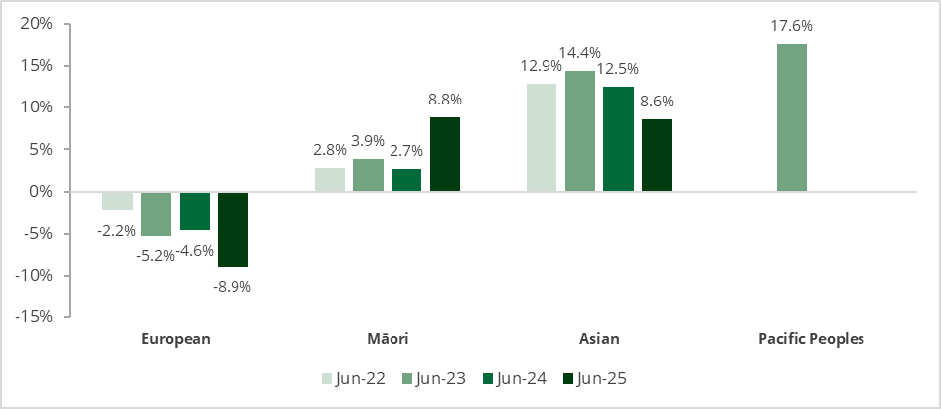
Ethnic Pay Gaps

Bar chart of ethnic pay gaps (2022-2025): European -2.2% to -8.9%; Māori 2.8% to 8.8%; Asian 12.9% to 8.6%; Pacific Peoples 17.6% (latest shown).

Progress against Te Kawa Mataaho Papa Pounamu Commitments

As required by Te Kawa Mataaho Public Service Commission, we have continued to make progress against Papa Pounamu Commitments.

Te urupae i te mariu | Addressing bias
  • 95.2 percent of NZSIS people leaders and 100 percent of our senior management completed our Understanding & Managing Unconscious Bias learning module.
Te āheinga ā-ahurea | Cultural competence
  • We have further refined our Pasifika Matters Workshop, which explores the diversity of the Pacific Island region and the relationship with, and experience of, Pasifika people in Aotearoa New Zealand. 
  • We continued to deliver workshops which develop our people’s capability to engage effectively with Iwi and Māori in undertaking our national security functions. These are key to ensuring we can attract and retain the talent required to achieve our national security outcomes.
Hautūtanga ngākau tuwhera | Inclusive Leadership
  • We launched our new People Leaders programme, designed to provide a clear understanding of how to manage, and also manage within the context of our workforce. The programme follows best practice inclusive leadership practices, as well as other internal frameworks, such as our recently completed Behavioural Competency Framework – which is being implemented in 2025/26. All current People Leaders are expected to complete the programme. Following this, all new People Leaders will complete the programme within three months of beginning their Leadership position. 
  • We finalised our new People Leader Pathway. The pathway is designed to support our People Leaders accessibility to essential learning, as well as recommended learning, all of which covers content from Management, Leadership, and Coaching practices. This will be launched to all People Leaders in 2025/26.
Ngā tūhononga e kōkiritia ana e ngā kaimahi | Employee-led networks
  • We formally launched our newest employee-led network – Te Kāhui Māori, which is open to all staff who identify as Māori and/or have a strong interest in, or connection to, Te Ao Māori. Together, our Te Kāhui Māori employee-led network and Te Ao Māori team developed tikanga and kawa guidance for the NZIC, aimed at ensuring our people are able to lead and support mihi whakatau and pōwhiri.
Hautūtanga Kākano Rau | Fostering diverse leadership

We will be exploring this further in the next iteration of our Diversity and Inclusion Strategy, and new Workforce Capability Strategy, which are due to be delivered in 2025/26 and 2026/27 respectively.

Providing a safe and healthy workplace

The health, safety and wellbeing function exists to protect our people and support our People Leaders to meet their responsibilities under the Health and Safety at Work Act 2015. This includes providing clear advice, building capability and enabling leaders to exercise due diligence. By fostering safe, healthy and supportive environments, we support the mission by helping everyone succeed in their roles and thrive at work.

Governance and leadership

As part of the transition programme, a new vision for future-state governance was developed. This included the finalisation of new terms of reference for our joint GCSB and NZSIS Health and Safety Governance Groups. These groups include all senior leaders from each agency. Together, they exercise due diligence and ensure health, safety and wellbeing are strategically prioritised.

We continue to strengthen engagement through our Health and Safety Representatives. Investment in Health and Safety Representative training and support was highlighted by our 2025 Health and Safety Representative Conference. Leaders also joined Health and Safety Representatives on frontline work area walks to better understand the realities of “work as done”.

This year, we reviewed our Health, Safety and Wellbeing Policy to reinforce our commitment to continual improvement and practical risk management. Our Wellbeing Psychology Services Policy, including psychosocial and psychological support services, was also reviewed to better reflect the needs of our people.

Capability and capacity

Senior leaders are active participants in the Business Leaders’ Health and Safety Forum. We are also members of the Government Health and Safety Lead, where we delivered a Positive Workplace Cultures programme in July 2024, to support safer, more respectful workplaces.

Risk management

We continue to build a deeper understanding of our critical risks by engaging directly with workers through targeted surveys and structured analysis. These insights help us explore how our people interact with high-consequence risks in practice and ensure our risk management strategies reflect real-world work.

At the same time, we are strengthening our approach to more frequent, lower-impact risks by embedding hazard and risk management frameworks that build frontline capability and ownership. This includes equipping workers and teams with the tools and confidence to proactively identify, assess and respond to risk in diverse working environments.

Building our Māori Cultural Capability

Like with other enabling functions in our agencies, the NZSIS and the GCSB have a shared Te Ao Māori team, whose insights helped reset our respective organisational strategies. Our Māori Cultural Capability is key to both organisational strategies, which signal the shared ambition to be an honourable and capable Treaty partner. Building our Māori cultural capability therefore continues to be a critical factor in enabling our people, systems and processes to give effect to the Treaty of Waitangi. 

The Māori Outcomes Strategy – He Waka Haumaru – continues to provide a roadmap in lifting organisational Māori cultural capability. The strategy is supported by three strategic pou outlined below, which are each underpinned with objectives and initiatives.

Kia Hono - Trusted partnerships

We continued to engage with Iwi Chairs and strengthen relationships with mana whenua this year. Work remains underway to enhance our service delivery to improve national security outcomes for Māori. 

Kia Maia – Culturally Capable

We continue to provide various learning and development opportunities for staff to build their competency in te reo Māori. During the reporting period, we released new online courses focussed on increasing knowledge in Te Ao Māori and the Treaty of Waitangi. Tikanga Māori continues to be an integral part of workplace culture, extending through to the formal welcomes for new staff, international guests and delegations. Our Māori staff network, Te Kāhui Māori, plays a leading role in uplift activities and events. 

Kia Manawanui – Building Resilience

We initiated the formation of a Protective Security Māori Stakeholder Reference Group. The purpose of establishing this group was to seek expert advice on shaping protective security guidance to increase the accessibility, resonance and impact for Māori. The Reference Group meets on a bi-monthly basis and is assisting in the design and delivery of a new product for Māori audiences, and is identifying effective engagement channels and opportunities to partner for impact.

Carbon Neutral Government Programme

We continue to work through the requirements and challenges of the Carbon Neutral Government Programme (CNGP) and operating in an emissions and energy friendly manner. 

Independent Verification

The NZSIS has completed independent emission verification with Toitū against ISO14064-1:2018 for 2018/19 (our baseline year), as well as 2021/22, 2022/23, and 2023/24. The emissions reported here have not been independently verified for 2024/25 at the time of reporting.

The greenhouse gas emissions measurement (emissions data and calculations) reported in this annual report have been calculated in a variety of ways. These are based on solid supplier data, where it is available and practical, internal records, and an extrapolation of a sample of underlying financial records for certain emission sources. 

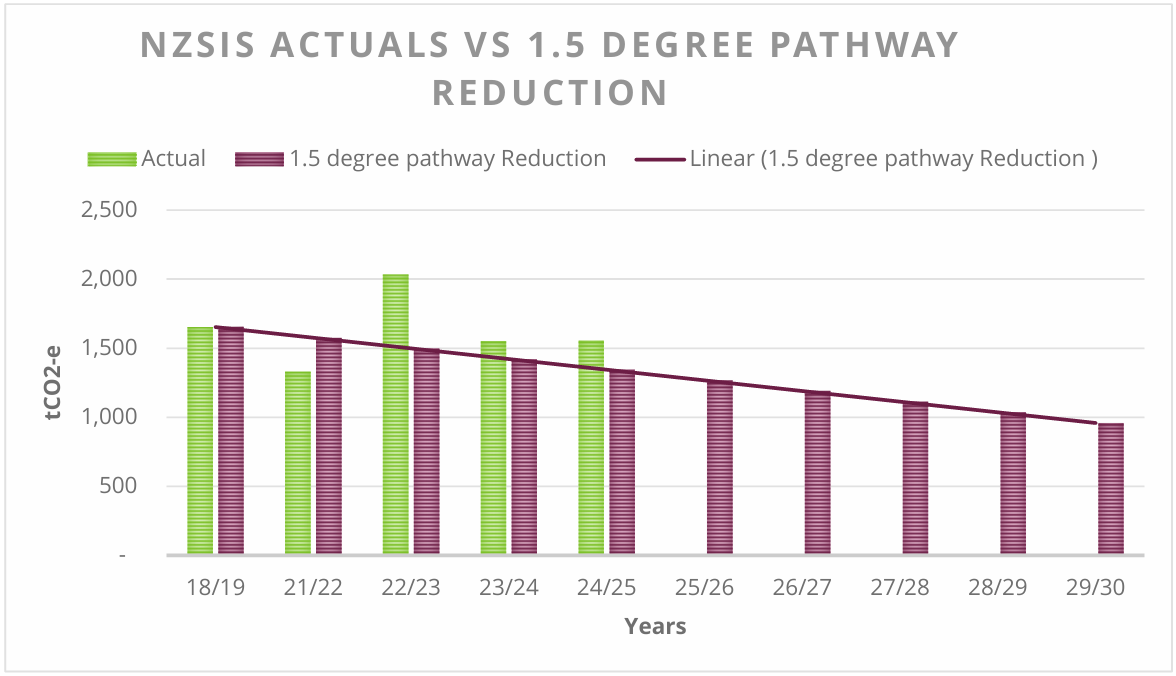
In 2024/25 we estimate we emitted 1,557 Tonnes CO2-e, based on our sampled data and extrapolation. This compares to our verified figure of 1,552Tonnes CO2-e in 2023/24. Most of our emissions came from passenger transport, as well as electricity and motor vehicles. 

Our Reduction Targets and Results to 1.5 Degree Pathway Reduction

The Government set the following emission reduction targets for government departments, as required by the CNGP.

2025 target: Gross emissions (all Categories) to be no more than 1,344 Tonnes CO2-e, or a 21 percent reduction in gross emissions (all Categories) compared to the base year, and

2030 target: Gross emissions (all Categories) to be no more than 959 Tonnes CO2-e, or a 42 percent reduction in gross emissions (all Categories) compared to base year.

Bar chart of emissions (tCO2-e) comparing actuals vs 1.5 degree Celsius pathway: actuals fluctuate ~1,300-2,050 (2018/19-2024/25), while the pathway declines steadily from ~1,650 to ~1,050 by 2029/30.

Financial Statements

Statement of Expenses and Capital Expenditure against Appropriation

For the year ended 30 June 2025

In accordance with Section 45E of the Public Finance Act 1989 (PFA), I report as follows: 

The “Total Appropriation” in the table above incorporates both operating expenses and 
capital expenditure forecast for the year. The “Actual Expenditure” includes the actual 
operating expenses and the actual capital expenditure incurred.  
  $000
Total Appropriation $122,834
Actual Expenditure $110,249

Independent Auditor’s Report

To the readers of the New Zealand Security Intelligence Service’s annual report for the year ended 30 June 2025
The Auditor-General is the auditor of the New Zealand Security Intelligence Service (the NZSIS). The Auditor-General has appointed me, Kelly Rushton, using the staff and resources of Audit New Zealand, to carry out, on his behalf, the audit of:

  • The statement of expenses and capital expenditure of the NZSIS for the year ended 30 June 2025 on page 40.
  • The end-of-year performance information of the NZSIS for the year ended 30 June 2025 on pages 25 to 29. The end-of-year performance information presented is the unclassified performance information and is a subset of the NZSIS’ full performance information for the appropriation.

Opinion

In our opinion:

  • The statement of expenses and capital expenditure incurred in relation to the appropriation for the year ended 30 June 2025 is presented fairly, in all material respects, in accordance with the requirements of section 221(4)(a) of the Intelligence and Security Act 2017. 
  • The presented end-of-year performance information accurately reports, in all material respects, the NZSIS’ actual performance against the presented performance measures.

Our audit was completed on 30 September 2025. This is the date at which our opinion is expressed.

Basis for our opinion

We carried out our audit in accordance with the Auditor-General’s Auditing Standards, which incorporate the Professional and Ethical Standards, the International Standards on Auditing (New Zealand), and New Zealand Auditing Standard 1 (Revised): The Audit of Service Performance Information issued by the New Zealand Auditing and Assurance Standards Board. Our responsibilities under those standards are further described in the Responsibilities of the auditor section of our report.

We have fulfilled our responsibilities in accordance with the Auditor-General’s Auditing Standards. 

We believe that the audit evidence we have obtained is sufficient and appropriate to provide a basis for our audit opinion.

Responsibilities of the Director-General of Security for the information to be audited

The Director-General of Security is responsible on behalf of the NZSIS for:

  • Preparing a statement of expenses and capital expenditure of the NZSIS that is presented fairly, in all material respects, in accordance with the requirements of section 221(4)(a) of the Intelligence and Security Act 2017. 
  • Preparing end-of-year performance information for the appropriation that provides an appropriate and meaningful basis to assess what has been achieved with the appropriation and fairly presents what has been achieved and that complies with generally accepted accounting practice in New Zealand.
  • Selecting from the full end-of-year performance information for the appropriation the  unclassified performance information, that is a subset of the NZSIS’ full performance information, and presenting unclassified performance information that accurately reports, in all material respects, the NZSIS’ actual performance against the unclassified performance measures. 

The Director-General of Security is responsible for such internal control as is determined is necessary to enable the preparation of the information to be audited that is free from material misstatement, whether due to fraud or error. 

In preparing the information to be audited, the Director-General of Security is responsible on behalf of the NZSIS for assessing the NZSIS’ ability to continue as a going concern. 

The Director-General of Security’s responsibilities arise from the Intelligence and Security Act 2017 and the Public Finance Act 1989.

Responsibilities of the auditor for the information to be audited

Our objectives are to obtain reasonable assurance about whether the information we audited, as a whole, is free from material misstatement, whether due to fraud or error, and to issue an auditor’s report that includes our opinion. 

Reasonable assurance is a high level of assurance, but is not a guarantee that an audit carried out in accordance with the Auditor-General’s Auditing Standards will always detect a material misstatement when it exists. Misstatements are differences or omissions of amounts or disclosures, and can arise from fraud or error. Misstatements are considered material if, individually or in the aggregate, they could reasonably be expected to influence the decisions of readers, taken on the basis of the information we audited.

For the budget information reported in the information we audited, our procedures were limited to checking that the information agreed to the Estimates of Appropriations for the Government of New Zealand for the Year Ending 30 June 2025.

We did not evaluate the security and controls over the electronic publication of the information we audited. 

As part of an audit in accordance with the Auditor-General’s Auditing Standards, we exercise professional judgement and maintain professional scepticism throughout the audit. Also:

  • We identify and assess the risks of material misstatement of the information we audited, whether due to fraud or error, design and perform audit procedures responsive to those risks, and obtain audit evidence that is sufficient and appropriate to provide a basis for our opinion. The risk of not detecting a material misstatement resulting from fraud is higher than for one resulting from error, as fraud may involve collusion, forgery, intentional omissions, misrepresentations, or the override of internal control.
  • We obtain an understanding of internal control relevant to the audit in order to design audit procedures that are appropriate in the circumstances, but not for the purpose of expressing an opinion on the effectiveness of the NZSIS’ internal control.
  • We evaluate the appropriateness of accounting policies used and the reasonableness of accounting estimates and related disclosures made by the Director-General of Security.
  • We evaluate whether the end-of-year performance information that is presented accurately reports, in all material respects, the NZSIS’ actual performance against the presented performance measures. 
  • We evaluate whether the statement of expenses and capital expenditure has been prepared in accordance with legislative requirements.
  • We conclude on the appropriateness of the use of the going concern basis of accounting by the Director-General of Security. 
  • We evaluate the overall presentation, structure and content of the information we audited, including the disclosures, and whether the information we audited represents the underlying transactions and events in a manner that achieves fair presentation.

We communicate with the Director-General of Security regarding, among other matters, the planned scope and timing of the audit and significant audit findings, including any significant deficiencies in internal control that we identify during our audit. 

Our responsibilities arise from the Public Audit Act 2001.

Other information

The Director-General of Security is responsible for the other information. The other information comprises all of the information included in the annual report other than the information we audited and our auditor’s report thereon.

Our opinion on the information we audited does not cover the other information and we do not express any form of audit opinion or assurance conclusion thereon.

Our responsibility is to read the other information. In doing so, we consider whether the other information is materially inconsistent with the information we audited or our knowledge obtained in the audit, or otherwise appears to be materially misstated. If, based on our work, we conclude that there is a material misstatement of this other information, we are required to report that fact. We have nothing to report in this regard.

Independence

We are independent of the NZSIS in accordance with the independence requirements of the Auditor-General’s Auditing Standards, which incorporate the independence requirements of Professional and Ethical Standard 1: International Code of Ethics for Assurance Practitioners (including International Independence Standards) (New Zealand) issued by the New Zealand Auditing and Assurance Standards Board. 

Other than in our capacity as auditor, we have no relationship with, or interests, in the NZSIS.

Kelly Rushton
Audit New Zealand
On behalf of the Auditor-General
Wellington, New Zealand

Other matters

Statement on Warrants

In accordance with section 221(2) of the ISA, the following statements are provided for the period 1 July 2024 to 30 June 2025. 

Co-operation (section 221(2)(a) and (b) of the ISA)

Assistance was provided under section 13(1)(b) of the ISA to the New Zealand Police on two occasions to facilitate their functions. No assistance was provided to New Zealand Defence Force under section 13(1)(b). 

No assistance was provided to other agencies under section 14 of the ISA to respond to an imminent threat.

Intelligence Warrants (section 221(2)(c) to (g) of the ISA)

Type 1 intelligence warrants 

a.      Sixteen applications for Type 1 intelligence warrants were made and approved under sections 58 and 59 of the ISA. No applications under sections 58 or 59 were declined.

b.     No applications for an urgent Type 1 intelligence warrant were made under section 71 of the ISA. No applications under section 71 were declined.

c.      No applications for a joint Type 1 intelligence warrant were made under section 56 of the ISA.

Type 2 intelligence warrants

a.      One application for a Type 2 intelligence warrant was made and approved under section 60 of the ISA. No applications under section 60 were declined.

b.     No applications for an urgent Type 2 intelligence warrant were made under section 72 of the ISA.

c.      No applications for a joint Type 2 intelligence warrant were made under section 56 of the ISA.

Very Urgent authorisations (section 221(2)(1)(e) of the ISA

No very urgent authorisations were given by the Director-General under section 78 of the ISA.

Restricted Information (section 221(2)(f) of the ISA)

No applications were made for permission to access restricted information under section 136 of the ISA.

Business Records Directions (section 221(2)(h) of the ISA)

312 business records directions were issued to business agencies under section 150 of the ISA.