
Organisational health and capability
Our people
The NZSIS continues to prioritise initiatives to attract and retain a skilled, capable, motivated and diverse workforce, including competitive remuneration, closing gender and ethnic pay gaps, investing in employee development and fostering an inclusive culture. The NZSIS shares corporate service and enablement functions with the GCSB.
Workforce changes
The NZSIS and the GCSB undertook a joint work programme in late 2023 to ensure our two agencies are financially sustainability in the longer term, and in the context of the current fiscal environment. This included a joint review of our workforces in 2024. This was separate from the efficiency savings sought through the Budget 2024 Initial Baseline Exercise. The change process also focused on maintaining core business, maximising alignment between the agencies and reducing unnecessary duplication.
The change process addressed these cost pressures in the near term. It involved the reallocation of vacancies and certain roles, including disestablishing some roles, and redeploying some of our shared staff in joint enabling functions between the NZSIS and the GCSB. A small number of people from across the GCSB and NZSIS were made redundant through this change process. This change process also led to the creation of roles within new organisational structures. The changes were implemented in early March 2025, with recruitment underway.
| 2020/21 | 2021/22 | 2022/23 | 2023/24 | 2024/25 | |
|---|---|---|---|---|---|
| Headcount | 405 | 391 | 428 | 457 | 403 |
| Full-time equivalents (FTEs) |
397.2 | 384.9 | 420.2 | 449.4 | 396.1 |
| Average age (years) |
40.6 | 41.2 | 40.9 | 41.8 | 42.9 |
| Unplanned turnover (percent) |
12.5 | 20.3 | 11.3 | 11.0 | 11.5 |
| Average length of service (years) |
5.1 | 5.6 | 5.6 | 5.5 | 6.3 |
Promoting diversity and inclusion
Like New Zealand, our workforce and work environment is diverse, and our collective diversity is celebrated and embraced. Our mission of keeping New Zealand and New Zealanders safe from significant national security threats is strengthened through the different ideas, perspectives, skills, experiences of our staff.
What we did to promote diversity and inclusion in 2024/25
We focused on maintaining work underway, for example, our Kia Toipoto Pay Gap Action Plan as required by Te Kawa Mataaho Public Service Commission. A key highlight of this was the finalisation of our Behavioural Competency Framework, and work to embed this into relevant people policies, processes and practices.
In addition, we developed and implemented our People Leader programme. This is a compulsory programme for all new managers, which embeds our essential diversity and inclusion training. We also continued to work on improving our data collection to better measure the impact of activities undertaken to embed diversity and inclusion within our people policies, processes and practices.
| 2020/21 | 2021/22 | 2022/23 | 2023/24 | 2024/25 | |
|---|---|---|---|---|---|
| Gender | |||||
| Male | 52.5% | 55.0% | 55.4% | 53.4% | 51.6% |
| Female | 46.0% | 44.5% | 43.2% | 46.0% | 47.1% |
| Undisclosed | 1.5% | 0.5% | 1.4% | 0.7% | 1.2% |
| Ethnicity | |||||
| European | 81.1% | 78.9% | 79.4% | 79.2% | 80.5% |
| New Zealander | 20.7% | 17.4% | - | - | - |
| New Zealand Māori |
6.1% | 6.1% | 7.5% | 7.5% | 6.9% |
| Asian | 5.6% | 6.8% | 6.8% | 5.9% | 5.9% |
| Pacific Peoples | 4.1% | 3.9% | 4.8% | 4.1% | 4.4% |
| Middle Eastern, Latin American, and African (MELAA) |
2.3% | 1.6% | 1.2% | 1.4% | 2.1% |
| Other | 0.3% | 0.5% | 14.5% | 14.0% | 12.3% |
| 2020/21 | 2021/22 | 2022/23 | 2023/24 | 2024/25 | |
|---|---|---|---|---|---|
| Gender | |||||
| Male | 61.5% | 42.9% | 61.9% | 55.0% | 50.0% |
| Female | 38.5% | 52.4% | 33.3% | 40.0% | 44.4% |
| Undisclosed | - | 4.8% | 4.8% | 5.0% | 5.6% |
| Ethnicity | |||||
| European | - | 85.7% | 81.0% | 85.0% | 88.9% |
| New Zealander | - | - | - | - | - |
| New Zealand Māori |
- | - | 4.8% | 10.0% | 5.6% |
| Asian | - | 4.8% | 4.8% | - | - |
| Pacific Peoples | - | - | - | - | - |
| Middle Eastern, Latin American, and African (MELAA) |
- | - | - | - | - |
| Other | - | 14.3% | 14.3% | 10.0% | 11.1% |
Gender Pay Gap
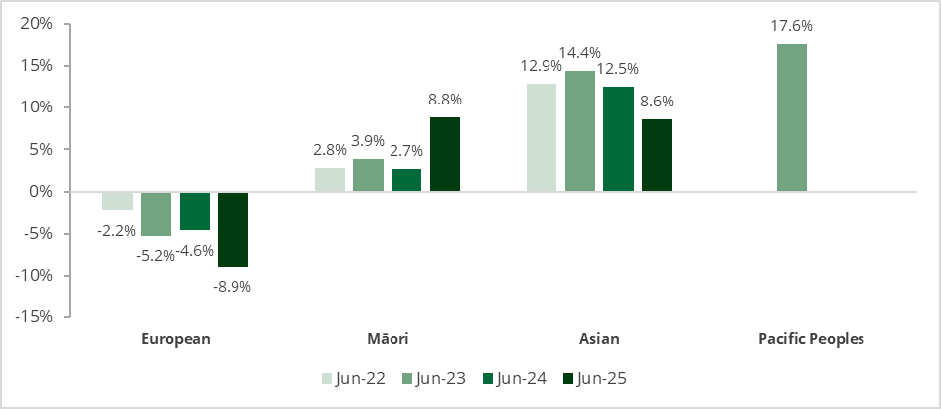
The gender pay gap is a high-level indicator of the difference between female and male earnings. It is a comparison of the annual fulltime salary earned by male and female staff, including permanent, fixed-term and seconded out staff in accordance with Te Kawa Mataaho guidance on calculating the gap.
Addressing our gender pay gap was a key feature of our 2021-2025 Diversity and Inclusion Strategy. As at 30 June 2025 our average gender pay gap was 5.8 percent. This is a decrease of 2.5 percentage points since last year.
Ethnic Pay Gaps
Progress against Te Kawa Mataaho Papa Pounamu Commitments
As required by Te Kawa Mataaho Public Service Commission, we have continued to make progress against Papa Pounamu Commitments.
Te urupae i te mariu | Addressing bias
- 95.2 percent of NZSIS people leaders and 100 percent of our senior management completed our Understanding & Managing Unconscious Bias learning module.
Te āheinga ā-ahurea | Cultural competence
- We have further refined our Pasifika Matters Workshop, which explores the diversity of the Pacific Island region and the relationship with, and experience of, Pasifika people in Aotearoa New Zealand.
- We continued to deliver workshops which develop our people’s capability to engage effectively with Iwi and Māori in undertaking our national security functions. These are key to ensuring we can attract and retain the talent required to achieve our national security outcomes.
Hautūtanga ngākau tuwhera | Inclusive Leadership
- We launched our new People Leaders programme, designed to provide a clear understanding of how to manage, and also manage within the context of our workforce. The programme follows best practice inclusive leadership practices, as well as other internal frameworks, such as our recently completed Behavioural Competency Framework – which is being implemented in 2025/26. All current People Leaders are expected to complete the programme. Following this, all new People Leaders will complete the programme within three months of beginning their Leadership position.
- We finalised our new People Leader Pathway. The pathway is designed to support our People Leaders accessibility to essential learning, as well as recommended learning, all of which covers content from Management, Leadership, and Coaching practices. This will be launched to all People Leaders in 2025/26.
Ngā tūhononga e kōkiritia ana e ngā kaimahi | Employee-led networks
- We formally launched our newest employee-led network – Te Kāhui Māori, which is open to all staff who identify as Māori and/or have a strong interest in, or connection to, Te Ao Māori. Together, our Te Kāhui Māori employee-led network and Te Ao Māori team developed tikanga and kawa guidance for the NZIC, aimed at ensuring our people are able to lead and support mihi whakatau and pōwhiri.
Hautūtanga Kākano Rau | Fostering diverse leadership
We will be exploring this further in the next iteration of our Diversity and Inclusion Strategy, and new Workforce Capability Strategy, which are due to be delivered in 2025/26 and 2026/27 respectively.
Providing a safe and healthy workplace
The health, safety and wellbeing function exists to protect our people and support our People Leaders to meet their responsibilities under the Health and Safety at Work Act 2015. This includes providing clear advice, building capability and enabling leaders to exercise due diligence. By fostering safe, healthy and supportive environments, we support the mission by helping everyone succeed in their roles and thrive at work.
Governance and leadership
As part of the transition programme, a new vision for future-state governance was developed. This included the finalisation of new terms of reference for our joint GCSB and NZSIS Health and Safety Governance Groups. These groups include all senior leaders from each agency. Together, they exercise due diligence and ensure health, safety and wellbeing are strategically prioritised.
We continue to strengthen engagement through our Health and Safety Representatives. Investment in Health and Safety Representative training and support was highlighted by our 2025 Health and Safety Representative Conference. Leaders also joined Health and Safety Representatives on frontline work area walks to better understand the realities of “work as done”.
This year, we reviewed our Health, Safety and Wellbeing Policy to reinforce our commitment to continual improvement and practical risk management. Our Wellbeing Psychology Services Policy, including psychosocial and psychological support services, was also reviewed to better reflect the needs of our people.
Capability and capacity
Senior leaders are active participants in the Business Leaders’ Health and Safety Forum. We are also members of the Government Health and Safety Lead, where we delivered a Positive Workplace Cultures programme in July 2024, to support safer, more respectful workplaces.
Risk management
We continue to build a deeper understanding of our critical risks by engaging directly with workers through targeted surveys and structured analysis. These insights help us explore how our people interact with high-consequence risks in practice and ensure our risk management strategies reflect real-world work.
At the same time, we are strengthening our approach to more frequent, lower-impact risks by embedding hazard and risk management frameworks that build frontline capability and ownership. This includes equipping workers and teams with the tools and confidence to proactively identify, assess and respond to risk in diverse working environments.
Building our Māori Cultural Capability
Like with other enabling functions in our agencies, the NZSIS and the GCSB have a shared Te Ao Māori team, whose insights helped reset our respective organisational strategies. Our Māori Cultural Capability is key to both organisational strategies, which signal the shared ambition to be an honourable and capable Treaty partner. Building our Māori cultural capability therefore continues to be a critical factor in enabling our people, systems and processes to give effect to the Treaty of Waitangi.
The Māori Outcomes Strategy – He Waka Haumaru – continues to provide a roadmap in lifting organisational Māori cultural capability. The strategy is supported by three strategic pou outlined below, which are each underpinned with objectives and initiatives.
Kia Hono - Trusted partnerships
We continued to engage with Iwi Chairs and strengthen relationships with mana whenua this year. Work remains underway to enhance our service delivery to improve national security outcomes for Māori.
Kia Maia – Culturally Capable
We continue to provide various learning and development opportunities for staff to build their competency in te reo Māori. During the reporting period, we released new online courses focussed on increasing knowledge in Te Ao Māori and the Treaty of Waitangi. Tikanga Māori continues to be an integral part of workplace culture, extending through to the formal welcomes for new staff, international guests and delegations. Our Māori staff network, Te Kāhui Māori, plays a leading role in uplift activities and events.
Kia Manawanui – Building Resilience
We initiated the formation of a Protective Security Māori Stakeholder Reference Group. The purpose of establishing this group was to seek expert advice on shaping protective security guidance to increase the accessibility, resonance and impact for Māori. The Reference Group meets on a bi-monthly basis and is assisting in the design and delivery of a new product for Māori audiences, and is identifying effective engagement channels and opportunities to partner for impact.
Carbon Neutral Government Programme
We continue to work through the requirements and challenges of the Carbon Neutral Government Programme (CNGP) and operating in an emissions and energy friendly manner.
Independent Verification
The NZSIS has completed independent emission verification with Toitū against ISO14064-1:2018 for 2018/19 (our baseline year), as well as 2021/22, 2022/23, and 2023/24. The emissions reported here have not been independently verified for 2024/25 at the time of reporting.
The greenhouse gas emissions measurement (emissions data and calculations) reported in this annual report have been calculated in a variety of ways. These are based on solid supplier data, where it is available and practical, internal records, and an extrapolation of a sample of underlying financial records for certain emission sources.
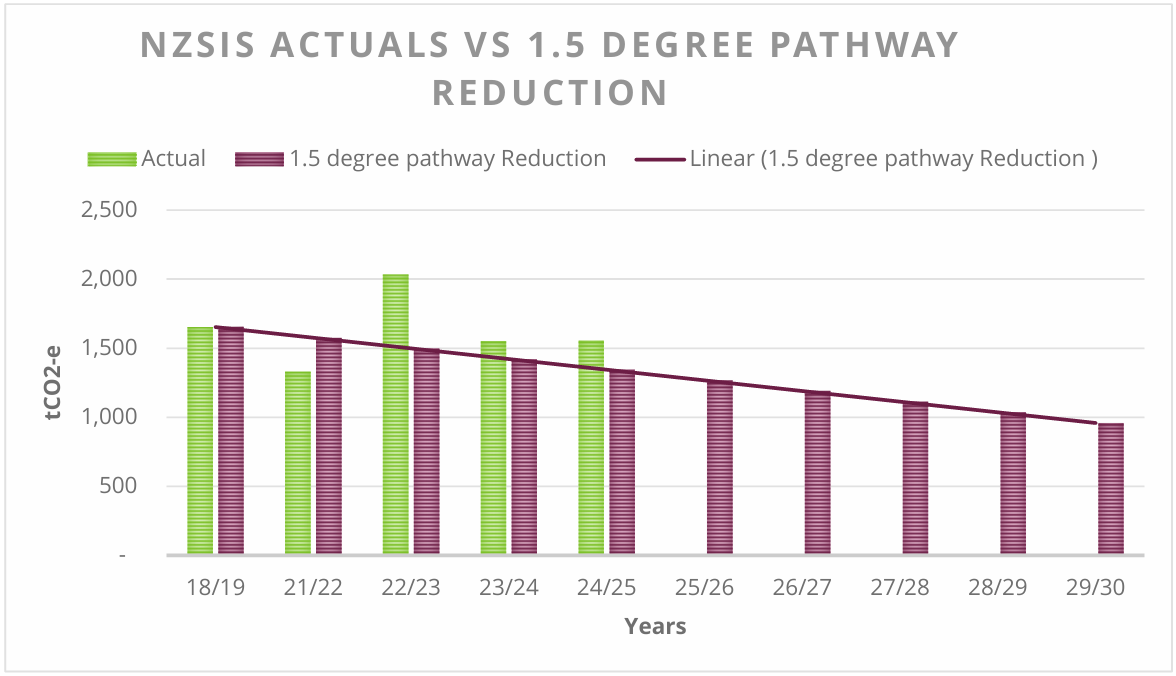
In 2024/25 we estimate we emitted 1,557 Tonnes CO2-e, based on our sampled data and extrapolation. This compares to our verified figure of 1,552Tonnes CO2-e in 2023/24. Most of our emissions came from passenger transport, as well as electricity and motor vehicles.
Our Reduction Targets and Results to 1.5 Degree Pathway Reduction
The Government set the following emission reduction targets for government departments, as required by the CNGP.
2025 target: Gross emissions (all Categories) to be no more than 1,344 Tonnes CO2-e, or a 21 percent reduction in gross emissions (all Categories) compared to the base year, and
2030 target: Gross emissions (all Categories) to be no more than 959 Tonnes CO2-e, or a 42 percent reduction in gross emissions (all Categories) compared to base year.