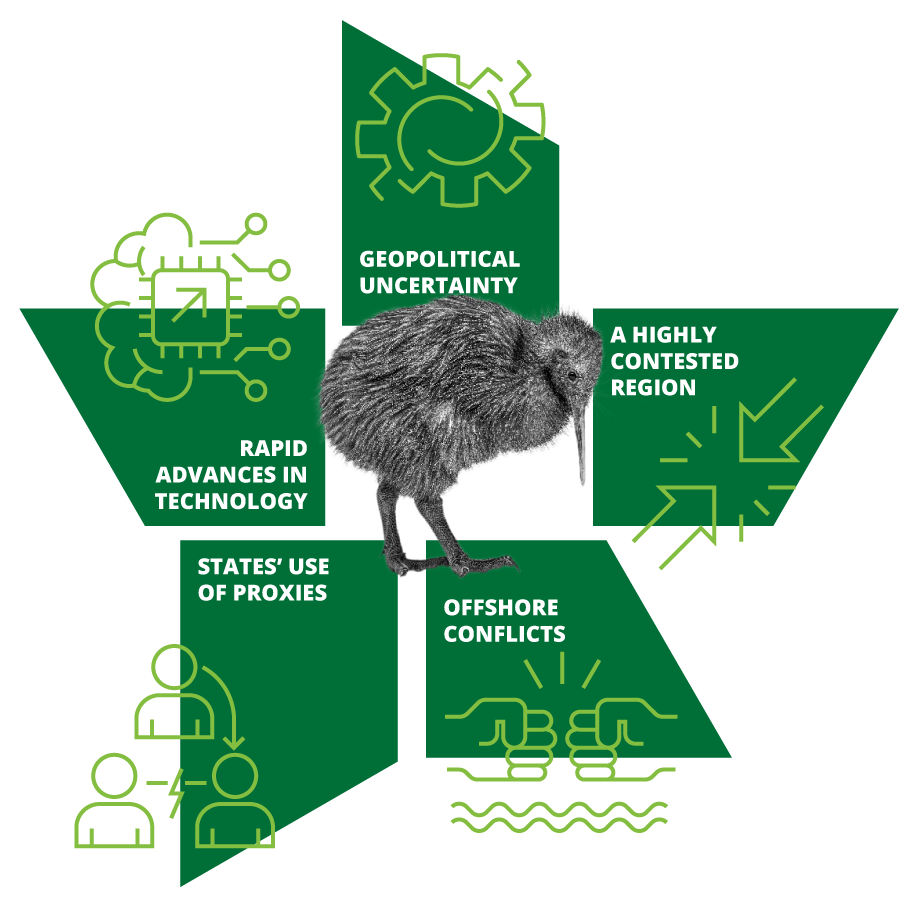
Geopolitical uncertainty

As a small, geographically isolated country that depends on international trade and connectivity for our prosperity, the world is becoming increasingly challenging for New Zealand to navigate.
New Zealand’s relationships and our innovation, our location in the South Pacific, and our close proximity to Antarctica all make our country geopolitically relevant. This has been positive for our international reputation and our economic prosperity, but that relevance is bringing downstream threats to our national security.
We have previously benefited from a generally stable global geopolitical outlook, in which our key interests could be pursued and maintained through diplomacy, structured cooperation, and engagement in multilateral forums. But many of the assumptions we have relied on in pursuing our interests are now being challenged. Norms and rules of importance to us are being undermined. Overall, geopolitics is now more unstable and unpredictable. In this deteriorating global environment, New Zealanders need to consider how to maintain the national interest, protect what matters and continue to prosper.
Our 2025 report made a similar assessment of the global environment, and the downward trajectory will almost certainly continue for the immediate future.
Global upheaval brings with it acute national security threats for New Zealand, brought about by the downstream effects of aggressive competition between states for control over technology, resources, supply chains and increasingly regional influence.
States’ pursuit of strategic advantage is affecting New Zealand’s interests. Non-public information is increasingly sought, including policy insights, intellectual property or data sets. States are unsentimental in their pursuit of this information. They may seek to dupe a government insider with a lucrative job offer or try to bust through a cyber backdoor. Homegrown technological innovation, particularly that which has potential military uses like our rapidly expanding space sector, is also under threat from state-sponsored espionage.
Foreign interference activity ramps up during these periods of upheaval. Authoritarian states seek to keep diaspora populations abroad under tight control so they can maintain their official narrative and lower the risk of perceived dissent. State proxies use deception and at times corruption to build long-term influence with decision makers.
States will also seek to exploit the already highly polarised online world to stoke social instability and further their global interests.
New Zealand can’t opt out or completely shield itself from these global trends – our prosperity and way of life depends on being connected with the rest of the world. Instead, we all have a role in managing the risks and minimising the negative impacts.
A highly contested region
 New Zealand’s domestic security depends in no small part on the stability and security of our wider Pacific region.
New Zealand is fortunate the Pacific is generally a peaceful region. There is the potential, however, for our relatively small economies and government systems to become overwhelmed by the growing number of security challenges we collectively face.
All Pacific Island countries are faced with the challenge of navigating an unpredictable strategic environment in which the region has become a space contested by major powers.
Strategic competition happens in the Pacific due to the region’s sheer size, the many maritime trade routes and critical ports, natural resources (especially fisheries, but increasingly also sea-bed minerals), and voting rights in international forums where foreign powers seek influence.
This contest brings opportunities as well as risks. Attention from major powers brings economic opportunities, but some states are also carrying out deceptive and corruptive efforts to influence government policy and decision-making in ways that undermine the country’s sovereignty and national interests.
Balancing potential national security risks with opportunities for economic prosperity is an ongoing challenge for Pacific countries, including New Zealand, and will continue to be for the foreseeable future.
While there is naturally a range of approaches among Pacific Island countries on international issues, the region’s continued emphasis on procedure, regionalism and consensus stands out against a global backdrop marked in many places by polarisation, inertia and unilateral action.
Such an environment can make it difficult for malign external powers to conduct their deceptive influence campaigns with individual governments, but they will continue to try.
Many of the national security threats New Zealand faces that are outlined in this report are also experienced by our Pacific partners.
Offshore conflicts
 Offshore conflicts, such as those in Iran, Gaza and Ukraine, are contributing to the deterioration in global security. Concerning trends from these events have filtered through to our domestic environment.
Most visible is the violent rhetoric online and threatening or intimidating behaviour directed toward people or groups perceived to represent, support or oppose the conflicts.
Surges in violent rhetoric can be stimulated by developments during conflicts, such as high-profile incidents.
Some foreign states and violent extremists seeking to advance their own interests take advantage of the strong emotional and polarised reactions that offshore conflicts can evoke. This involves creating and spreading false or inaccurate information that provokes social and political division.
New Zealand communities are exposed to this inflammatory rhetoric, which sometimes exposes social tensions here. Some groups become stigmatised when an ‘us vs them’ mentality discourages nuanced and moderate views. Social disruption will be welcomed by state actors or violent extremists who seek to gain from any breakdown in social cohesion.
States’ use of proxies
 States using criminal proxies or other third parties to threaten their rivals have drawn increasing global attention over the past year.
Considered a type of grey-zone operation or a hybrid threat, this tactic represents an addition to the toolkit for coercive statecraft. These activities lie below the level of direct warfare and can include information operations, political and economic coercion, cyber-attacks, and violence by state-controlled or state-funded actors.
The use of proxies is not a new phenomenon. States like Iran have used designated terrorist entities to undertake activities for decades - notably Hezbollah and Hamas. The conflicts in Iran and Ukraine in particular have resulted in the emergence of several examples of this activity. Some states have used violent extremist and criminal groups to undertake attacks targeting people, religious sites and businesses in Western countries outside of conflict zones.
The use of proxies may be seen as especially appealing as it creates plausible deniability of the state’s involvement while inflicting physical damage.
While New Zealand has not experienced high harm activities by proxies as seen in other Western countries, some recent cyber-attacks are likely to be examples of proxy criminal groups being used in the New Zealand context. The broader use of coercive tools by states will likely be an emerging security challenge in the coming years and we need to be alert to the risk.
Rapid advances in technology
 Rapid advances in technology are constantly changing the nature of national security threats in New Zealand.
Generative artificial Intelligence (GenAI) systems, including large language models, offer major benefits for innovation, productivity and eventually prosperity. However, these tools can be also used to enable violent extremism, support state-sponsored foreign interference and to sow division within society.
Hostile states and violent extremist actors are seizing on GenAI capabilities to create and spread content that advances their ideological interests. GenAI makes it cheap and easy to create narratives that exploit psychological vulnerabilities and are tailored to resonate with personal interests or grievances. The technology also allows this information to be disseminated at scale.
GenAI is being used by some states to produce content that enables them to control narratives and villainise perceived opponents. It is also being designed to undermine government institutions and create divisions in society when doing so is useful to the state.
Similarly, violent extremists are using the same technology to create engaging material intended to evoke an emotional response in support of an ideological narrative.
Supporters of the Islamic State have used GenAI to generate and translate ideological content into multiple languages to appeal to a global audience, while white-identity motivated violent extremists have used GenAI to translate and modernise historical recordings of Adolf Hitler to appeal to a modern audience. New Zealanders are accessing this material and this is a factor in the radicalisation of some individuals.
AI impacts our information environment by amplifying polarising narratives and hiding the source of the content. New Zealanders consuming AI-generated content will mostly be unaware if the narrative was generated offshore or represents genuinely held beliefs.
As AI tools continue to advance, they will become even more effective at tailoring content to specific communities and interested groups. Global conflicts have created fertile ground for both state and violent extremist actors to generate false or misleading content. Information is often curated in a way that frames crises as “good versus evil”.
Violent extremists will seek to capitalise on emotive issues to radicalise and recruit individuals to their cause, while state actors use such inflection points to covertly influence public opinion and create divisions in society to advance their own interests.
In addition to creating and spreading content, GenAI tools have improved the sophistication and accessibility of established technologies including 3D printing and drones. It is possible these technologies could be utilised by hostile actors for malicious purposes before enhancements can be made to policy and legislation to safeguard their use.
Opportunities created by rapid advances in GenAI tools will need to be balanced by greater understanding of how they can exacerbate national security threats such as espionage, foreign interference and violent extremism.