
New Zealand’s Security Threat Environment

New Zealand's Security Threat Environment 2025

An assessment by the New Zealand Security Intelligence Service.

Introduction

New Zealand is facing the most challenging national security environment of recent times.

The New Zealand Security Intelligence Service (NZSIS) has noted further deterioration in the threat environment since last year’s report, largely driven by less stable relationships between states and increasing levels of polarisation and grievance.

Tucked away in the South Pacific, New Zealand may seem like a long way from global security hotspots, but the reality is much different. The make-up of our society, our economic connectedness, our international relationships and location in an increasingly contested region means New Zealand is impacted by the competition between states for power, influence and strategic advantage.

At the same time, the murky corners of the online world can be reached in a single click. A media feed filled with polarisation and grievance awaits anyone who is vulnerable to being led astray, or who is looking for fuel for their violent ideology.

The security environment is challenging because the nature of the threats we face is so varied and complex. Understanding why someone may be motivated to target New Zealand and those who live here is difficult to untangle and the ways this country may be targeted change rapidly.

Threats cannot always be eliminated, but it is possible to manage the risk from potential harms and vulnerabilities. This third annual threat assessment is about raising awareness so that government institutions, organisations and communities can have clear-eyed conversations on how to avoid or reduce harm.
It is important to understand the nature of other national security threats too. For example, to stay on top of trends in the cyber threat environment, it’s highly recommended to read the National Cyber Security Centre’s annual threat report.

Cyber Threat Reports | ncsc.govt.nz

How to read this assessment

The NZSIS is responsible for detecting, investigating, deterring and disrupting national security threats. Our current key priorities include violent extremism, terrorism, foreign interference and espionage. As such, these are the threats covered in this assessment.

This report is based on NZSIS intelligence insights gathered in New Zealand and from a local perspective. It should not be considered a Government policy document.

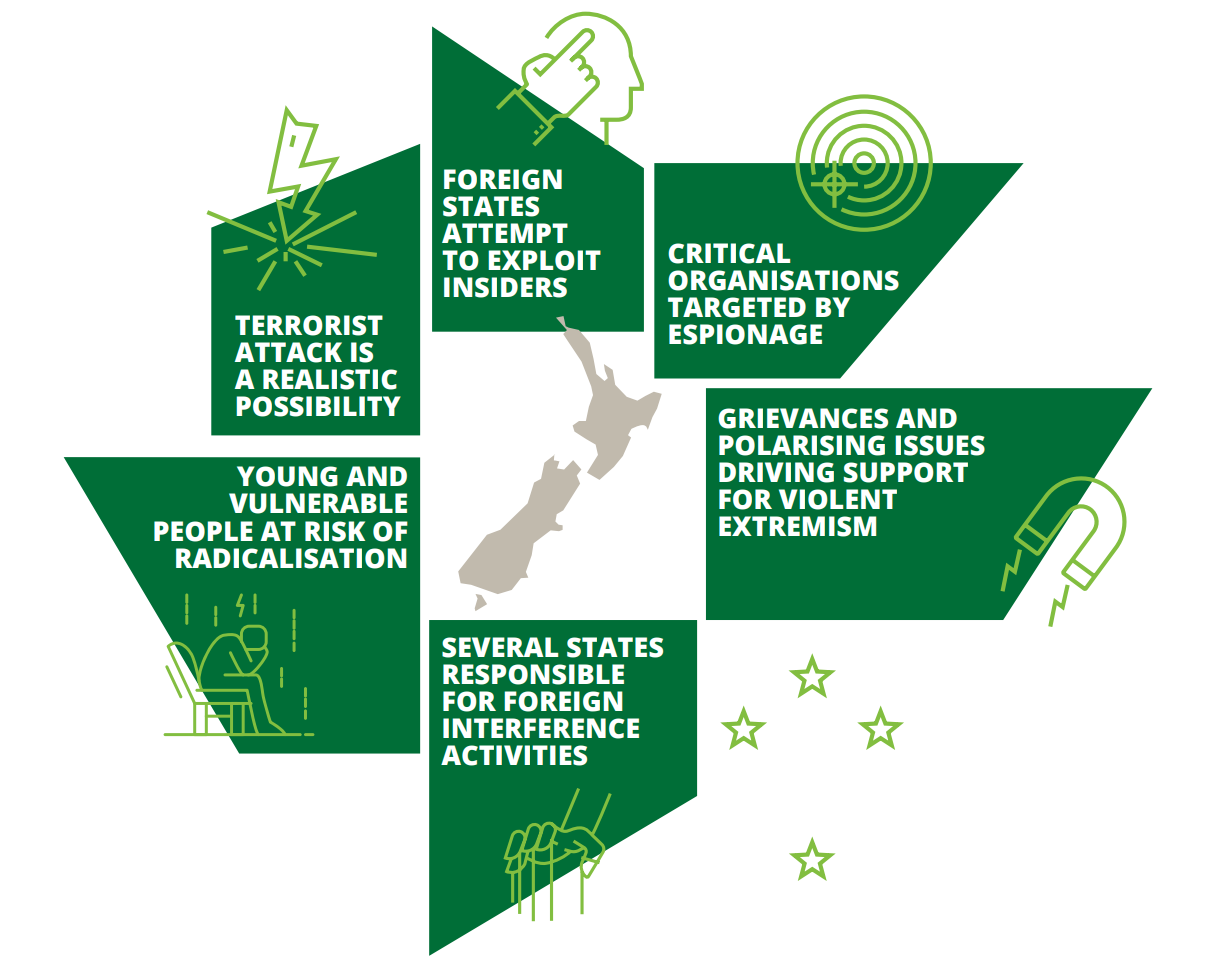
Infographic showing six security risks to New Zealand, arranged around a map of New Zealand. Full explanations appear later in this report.

The job of the NZSIS is more than just reporting on the threats we face. We want to work with organisations and communities to share our knowledge about how some of these harms can be avoided or managed.

Best practice security advice can be found within the foreign interference, espionage and insider sections. This is designed to help frame your thinking about security and give you more confidence to identify and manage these risks.

Real life case studies are included to demonstrate a snapshot of how these threats manifest in New Zealand. These represent just a small proportion of the kinds of activity being observed.

Read previous NZSIS threat assessments at www.nzsis.govt.nz/threat-assessment.

You may not see yourself, your organisation or your community impacted by the threats described in this report, but it is still valuable to discuss potential harms so you can work together to manage risk.

Finally, the NZSIS’s analysis is always enhanced by information received from members of the public. If you see or become aware of any concerning behaviour or activities related to violent extremism, terrorism, foreign interference or espionage then we strongly encourage you to let us know. 

Key assessments 2025

The NZSIS makes six key assessments about New Zealand’s threat environment in 2025:

  • The most plausible violent extremist attack scenario in New Zealand remains a lone actor who has radicalised online and prepares for violence without any intelligence forewarning. Any attacker is most likely to use easily accessible weapons.

  • Grievances and polarising issues in the online information space are almost certainly driving support for a range of violent extremist ideologies within New Zealand. No one ideology currently stands out as presenting a greater threat.

  • Young and vulnerable people in New Zealand are particularly at risk of radicalisation, especially while online.

  • Foreign interference activities continue in New Zealand with several states responsible. This includes activities regarded as transnational repression that often target diaspora communities.

  • It is almost certain there is undetected espionage activity that is harming New Zealand’s national interests. The NZSIS has had some success disrupting this activity, but foreign states continue to target New Zealand’s critical organisations, infrastructure and technology to steal sensitive information.

  • Some foreign states have attempted to exploit people inside public and private sector organisations in a deceptive, corruptive, or coercive manner, to gain influence and further their interests.